Alessandro Volta Demonstrating the World’s First Battery to Napoleon in 1801

Electrolytic Voltaic Pile is Replaced by a Nonelectrolytic Phonovoltaic Pile
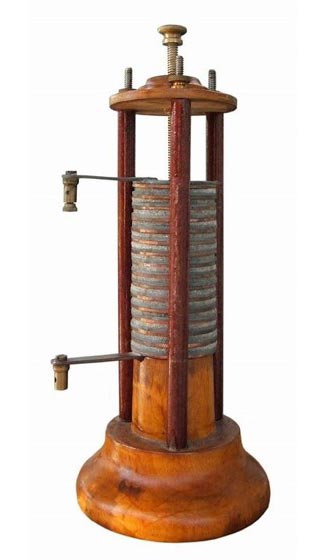
Alessandro Volta invented the world’s first electrochemical battery, shown above on the left, that comprises a pile of alternating copper and zinc electrodes intervened by a brine-soaked cloth electrolyte. An ionic dissociation resulted in positively-charged cations being displaced towards the copper cathode and negatively-charged anions being displaced towards the zinc anode, so as to establish an electromotive force between the dissimilar metallic electrodes. However, the ionic dissociation chemically exhausts itself, so as to cause the electromotive force to ultimately vanish. In many electrolytic batteries, such as modern lithium-ion batteries, the electrochemical process can be reversed so as to recharge the battery.
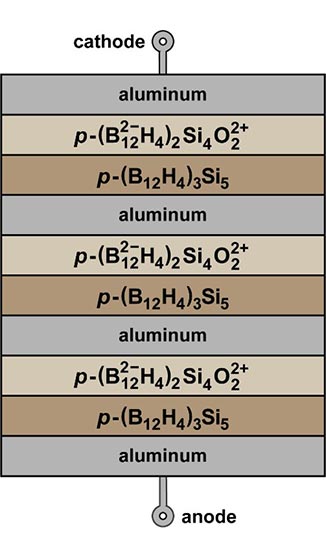
A revolutionary nonelectrolytic battery, shown above on the right, is a novel voltaic pile that comprises conjoined silaborane and oxysilaborane regions intervened by an aluminum electrode. The profound novelty of the nonelectrolytic battery, referred to as a phonovoltaic cell, is the absence of any chemical exhaustion of anions and cations due to a continual replenishment by latent heat extracted from the ambient in thermal equilibrium. The ability of a phonovoltaic cell to continuously replenish anions and cations, in thermal equilibrium and in the dark, is due to novel chemical properties of the supramolecular oxysilaborane genus invented by Pat Curran and assigned to SemiNuclear, Inc. in United States Patent No. 9,972,489.
As represented below, supramolecular oxysilaborane is a highly novel self-assembled guest-host supramolecule in which the guest molecules are bodily-rotating Majorana fermions and the host molecule comprises an irregular partial diamond-like lattice of silicon atoms and, possibly also, oxygen atoms. The bodily-rotating guest molecules behaving as Majorana fermions are physically artificial borane atoms with a natural boron nucleus residing at each vertex of a nearly-regular icosahedron. The bodily-rotating Majorana fermions exhibit a periodicity of 4π radians that is consistent with a spin-½ fermion. The bodily rotation of the spin-½ Majorana fermions is rigorously established by means of group theory on the Organizing Principles section of this website.
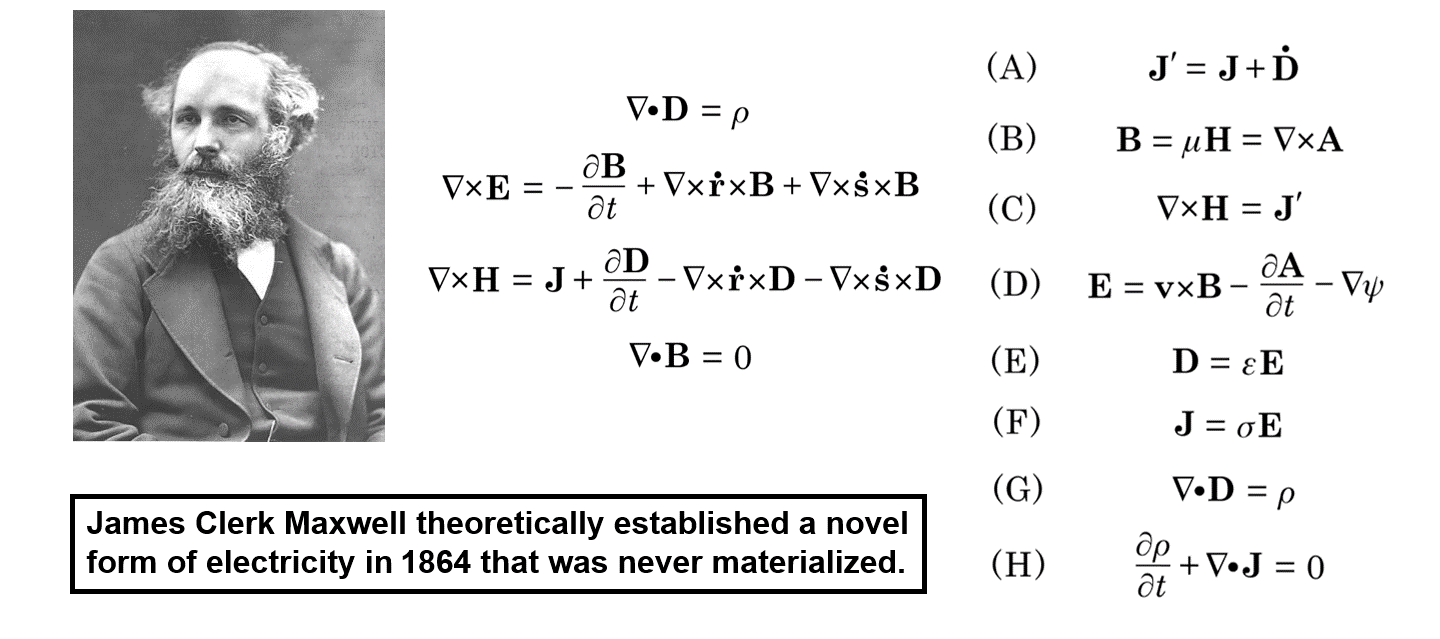
The coexistence of electricity as both a gas and a liquid has paternity in the original unification of electricity and magnetism in a paper entitled “A Dynamical Theory of the Electromagnetic Field” by James Clerk Maxwell that was read on December 8, 1864 at the Royal Society of London. Maxwell’s original equations (A)-(H) of 1864 are expressed below in a modern formulation. The four curl terms collectively describe the heretofore-unknown Aharonov-Bohm-Josephson effect that is responsible for electric charge replenishment in the inexhaustible phonovoltaic cell capable of inducing a societal transformation in renewable energy.
“According to the theory which I propose to explain, this ‘electromotive force’ is the force called into play during the communication of motion from one part of the medium to another, and it is by means of this force that the motion of one part causes motion in another part. When electromotive force acts on a conducting circuit, it produces a current, which, as it meets with resistance, occasions a continual transformation of electrical energy into heat, which is incapable of being restored again to the form of electrical energy by any reversal of the process. But when electromotive force acts on a dielectric it produces a state of polarization of its parts similar in distribution to the polarity of the parts of a mass of iron under the influence of a magnet, and like the magnetic polarization, capable of being described as a state in which every particle has its opposite poles in opposite conditions.
In a dielectric under the action of electromotive force, we may conceive that the electricity in each molecule is so displaced that one side is rendered positively and the other negatively electrical, but that the electricity remains entirely connected with the molecule, and does not pass from one molecule to another. The effect of this action on the whole dielectric mass is to produce a general displacement of electricity in a certain direction. This displacement does not amount to a current, because when it has attained to a certain value it remains constant, but it is the commencement of a current, and its variations constitute currents in the positive or the negative direction according as the displacement is increasing or decreasing.”
~James Clerk Maxwell, “A Dynamical Theory of the Electromagnetic Field”, 1864
James Clerk Maxwell previously generalized Faraday’s induction law in 1861 in a paper entitled “On Physical Lines of Force.” In Proposition XI of this paper, Maxwell derived the general relation governing the electric field in a moving body by considering both the motion of a body through space, as well as, the many-body reconfiguration due to a radiative coupling. In this manner, Maxwell generalized the modern Lorentz force such that the  term comprehends rotational phenomena due to an electromagnetic disturbance that is incomprehensible by the modern Lorentz force.
Whereas Maxwell’s displacement current density is due to a molecular polarization in response to an externally-impressed time-dependent electromotive force, the novel displacement current density comprised by  and
and  is contrary in the sense that a heretofore-unknown periodic molecular polarization occurs in response to an intrinsic time-translation symmetry breaking that sustains continuously-rotating guest molecules. The ability to sustain the continuous polarization of guest molecules in a stationary host molecular lattice is rigorously proven by means of group theory on the Organizing Principles section.
Maxwell generalized Faraday’s induction law by two effects  and
and  that have never been provided a physical basis. Similarly, Maxwell further generalized Ampère’s circuital law by two effects and that have never been provided a physical basis. Maxwell fully recognized that the true electric current must augment the conduction current with the time rate of change in the electric displacement
  . However, Maxwell unwittingly augmented the conduction current with only the time rate of change in the electric displacement due to Faraday’s induction. The generalization of Faraday’s induction law by and further generalizes Ampère’s circuital law by self-sustaining variations in the electric displacement current density and due to a time-translation symmetry breaking not recognized by Maxwell nor any subsequent physicist.
The point form of the generalization of Faraday’s induction law is implicitly contained within Maxwell’s original equations of the electromagnetic field of 1864. The integral form of Maxwell’s generalization of Faraday’s induction law results in the unification of the Aharonov-Bohm effect and the Josephson effect, so as to physically support nondispersive amplitude-modulated quadrupole matter waves that propagate through spacetime without any energy loss per the heretofore-unknown Aharonov-Bohm-Josephson effect. Said amplitude-modulated quadrupole matter waves behave as near-infrared X-rays never before known to exist.
Whereas soft X-rays have a minimum energy of 124 eV and hard X-rays have a minimum energy of 124 keV, the near-infrared X-rays supported by the synthetic oxysilaborane genus disclosed in United States Patent 9,972,489 have a much lower energy of 1.08 eV – which is the bandgap energy of monocrystalline silicon at the onset of bandgap narrowing. Similar to conventional X-rays, the near-infrared X-rays of oxysilaborane possess both a scalar energy and a vectorial momentum. It is by this means that oxysilaborane constitutes the ultimate topological insulator in which the topological invariant  of spacetime is preserved so as to support a beyond-BCS room-temperature superconductivity not heretofore known to be possible.
It is yet further significant that the near-infrared X-rays in oxysilaborane are due to a beyond-Faraday induction associated with Maxwell’s vector potential – without the involvement of any electric or magnetic field. In this manner, oxysilaborane supports the Aharonov-Bohm-Josephson effect in which topological electromotive forces are established without the aid of any field. Although the displacement of liquid electricity by near-infrared X-rays is due to a beyond-Faraday induction, there is no inductive coupling between nearby oxysilaborane topological insulators intervened by a conventional insulator supporting a displacement current.
The phonovoltaic cell shown below generates an electromotive force upon demand by means of the Aharonov-Bohm-Josephson effect in the manner described in International Patent Application Number PCT/US2017/064020 assigned to SemiNuclear, Inc.
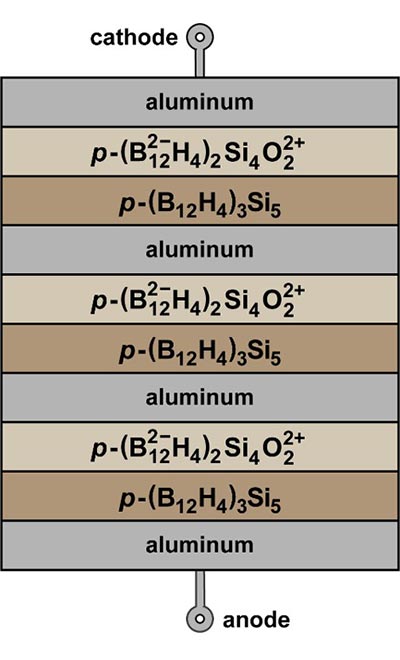
The above phonovoltaic cell behaves as a solid-state electronic heat pump in which the refrigerant is a quantum spin liquid that can be cyclically exchanged between liquid electricity and gaseous electricity in the manner portrayed by way of the following animation. The silaborane  region, shown on the left in the following animation, behaves as a p-type semiconductor with an ideally vanishing Seebeck coefficient of mixing of mobile electrons and mobile holes. The oxysilaborane
  region, shown on the right in the following animation, behaves as a p-type semiconductor with a large Seebeck coefficient of mixing due to the essential absence of mobile holes by virtue of the incorporation of oxygen atoms in a controlled manner.
The incorporation of oxygen in the oxysilaborane region eliminates the charge-conjugation symmetry of a spin-½ Majorana fermion, such that the artificial borane atoms thus support a gaseous electricity in which bipolaronic electron-pairs hop between the icosahedra of the artificial borane atoms. The absence of oxygen in the silaborane region preserves the charge-conjugation symmetry of a spin-½ Majorana fermion, such that quadrupole matter waves support a quantum spin liquid amongst the entangled artificial borane atoms. However, the long-range entanglement between the spin-½ Majorana fermions is broken in trace artificial borane atoms due to the nuclear electric quadrupole moment of the natural boron atoms.
The local breakdown of the long-range entanglement of spin-½ Majorana fermions in the silaborane region results in a trace concentration of bipolaronic electron-pairs and an equal number of bipolaronic hole-pairs due to disproportionation. This results in an ideally vanishing Seebeck coefficient of mixing in the silaborane region, such that mobile hole-pairs tend to diffuse on their own accord into the conjoined oxysilaborane region by virtue of Gibbs free energy of mixing. The oxysilaborane region supports the hopping of bipolaronic hole-pairs to the aluminum cathode, whereupon they can recombine with electron-pairs under closed-circuit conditions of the inexhaustible phonovoltaic cell.
The diffusion of bipolaronic hole-pairs from the silaborane region into the conjoined oxysilaborane region discharges heat quanta along with the electric charges. Charge neutrality is preserved in the silaborane region by virtue of an equal displacement of bipolaronic hole-pairs and bipolaronic electron-pairs in opposite directions. In comparison with the original voltaic pile of Alessandro Volta in 1799, the bipolaronic hole-pairs behave as cations and the bipolaronic electron-pairs behave as anions. In order to sustain a continuous current flow in a phonovoltaic cell, there is a continuous replenishment of the displaced cations and anions that are consumed in the delivery of an electric current to an impressed load.
With reference to the above animation of the solid-state electronic heat pump built into the phonovoltaic cell, the diffusion of cations (bipolaronic hole-pairs) from the silaborane region into the conjoined oxysilaborane region carries away heat into the electrical load. This lowers the temperature of the silaborane region, such that the long-range entanglement of silaborane region is thereby enhanced by an uncompensated increase in the entanglement entropy that causes artificial borane atoms to behave as spin-½ Majorana fermions. The decrease in entropy of the silaborane region is exactly compensated by an increase in the entanglement entropy of the individual artificial borane atoms.
The decrease in entropy of the silaborane region is limited by the entropy associated with the equipartition theorem. When this occurs, charge-conjugation symmetry is necessarily broken in individual artificial borane atoms so as to induce a self-thermalization that is clamped by the ambient temperature. The quantum localization is then broken by a disproportionation that transforms the quantum spin liquid into an electric gas in the form of bipolaronic electron-pairs and bipolaronic hole-pairs that hop amongst the trace icosahedral artificial borane atoms in which the charge-conjugation symmetry is broken. A latent heat of vaporization is extracted from the ambient, whereupon the phonovoltaic cell is restored to its original condition.
The latent heat of vaporization extracted from the ambient, under thermal equilibrium, is converted into a decrease in Gibbs free energy upon the discharge of current to an impressed electrical load. As the result, a phonovoltaic cell constitutes an entropy-to-energy converter behaving as an inexhaustible nonelectrolytic battery that constitutes a substantial advancement of existing electrolytic batteries in which the displacement of cations and anions supporting an electric current is necessarily exhausted. The phonovoltaic cell can be self-assembled by conventional processing in an MOCVD chemical reactor, so as to result in a low-cost carbon-free form of renewable energy capable of providing power upon demand, at any point of use and at any instant in time, by means of a natural atmospheric power distribution that preserves the radiative equilibrium of Earth's biosphere.
World Bank: One In Seven People Still Live Without Electricity

“No matter what we attempt to do, no matter to what fields we turn our efforts, we are dependent on power. Our economists may propose more economical systems of administration and utilization of resources, our legislators may make wiser laws and treaties, it matters little; that kind of help can be only temporary. If we want to reduce poverty and misery, if we want to give to every deserving individual what is needed for a safe existence of an intelligent being, we want to provide more machinery, more power. Power is our mainstay, the primary source of our many-sided energies. With sufficient power at our disposal we can satisfy most of our wants.”
~Nikola Tesla, Cassier’s Magazine, March 1897, pp.378-386
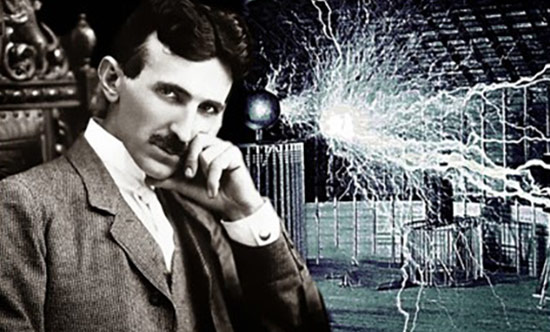

“But we shall not satisfy ourselves simply with improving steam and explosive engines or inventing new batteries; we have something much better to work for, a greater task to fulfill. We have to evolve means for obtaining energy from stores which are forever inexhaustible, to perfect methods which do not imply consumption and waste of any material whatever.”
~Nikola Tesla, Cassier’s Magazine, March 1897, pp.378-386
The direct conversion of entropy into energy achieves Tesla’s stated objective of “obtaining energy from stores which are forever inexhaustible” by means of the organizing principle of condensed matter. Although entropy is recognized as time’s arrow, the present laws of physics are agnostic in regard to time’s arrow. As a result, the scientific basis of the organizing principle of condensed matter is yet unknown. By remedying this epistemological deficiency, it becomes possible to directly transform ambient heat into electricity, without any fuel, at any place and at any time by a solid-state electronic heat pump that supports phase changes between quadrupole moments behaving as liquid electricity and electric charges behaving as gaseous electricity.
By advancing the battery invented by Alessandro Volta, so as to realize the dream of Nikola Tesla, FDR’s Rural Electrification of the New Deal can be extended around the world in order to ensure that all people are provided low-cost electricity upon demand, at any place and at any time, without the need for any energy infrastructure – such that the economic imbalance between have and have-not countries can be reduced while arresting the existential threat of climate.